Token Standards, What Are They?
Find out the details of four different token standards. We cover ERC-20, BEP-2, CW20, and Omni token standards.
Once you get involved in crypto, you will work with all kinds of different token standards. Probably without even realizing it. For instance, there are native tokens, stablecoins, or NFTs.
These token standards form sets of rules. The smart contracts must follow these rules. This allows the tokens to work with existing common standards. We are going to show four different tokens and explain them. We also are working on another article that discusses another four tokens. So let’s have a look at these four tokens.
Source: Pixabay/guaxipo
What Are Token Standards?
There are quite a few different tokens out there, and they all have a variety of standards. A common standard is the ERC standard. This is, for instance, for Ethereum tokens. In the same vein, each chain has its own standards.
All token standards are part of smart contracts. These smart contracts have sets of rules, so they can work on their respective blockchains. This can include token standards, of course. But it can also have library formats or name registries.
By setting or writing the standards, the smart contracts are now bound by them. This is important for token creation or transactions. In turn, the standards allow for smart contracts to talk easily between each other. Typically, this is for tokens on the same blockchain.
So, in other words, the token standards are subsets of the standards for smart contracts. We are going to look at four different tokens.
- ERC-20 token or Ethereum Request for Comment tokens.
- BEP-2 token of the Binance Chain.
- CW-20 token on CosmWasm.
- Omni token built on top of Bitcoin.
What Is the ERC-20 Token Standard?
The ERC-20 token standard is the most used token standard on Ethereum. The name Fabian Vogelsteller probably doesn’t ring a bell. However, he’s the person who proposed the Ethereum Request for Comment 20. This was back in November 2015. It sets the standard for fungible tokens on Ethereum. This means that each token is the same as the next one. All Ethereum-based tokens must follow the rules set by these standards.
You can use this token for a wide variety of functionalities. Among others:
- Transfer tokens between accounts.
- Show token balance in an account.
- Display total number of tokens available in a network.
This token has three optional functions:
- Token name
- Ticker symbol
- The divisibility. How many decimal places it will support? The most is 18.
Samples of ERC-20 tokens are Chainlink (LINK), Tether (USDT), or Loopring (LRC).
What Is the BEP-2 Token Standard?
The BEP-2 token is the standard for the Binance Chain. These tokens are only issued on the Binance Chain, and you can only use them there. In other words, this is the Binance CEX or DEX. The Binance Chain is part of a dual chain architecture. The other chain is the BNB Chain. This chain has smart contracts and dApps. It uses the BEP-20 token standard. More about this token in our other article on token standards. Both chains complement each other but, at the same time, are independent.
The native asset is the BNB token. Binance Chain uses this to pay for transaction fees. It is possible to swap BEP-2 tokens into identical BEP-20 tokens. As a BEP-20 token, it works everywhere in the Binance ecosystem. You can only trade BEP-2 tokens on the Binance DEX. We wrote an earlier article that compares the BEP-2 versus the BEP-20 token.
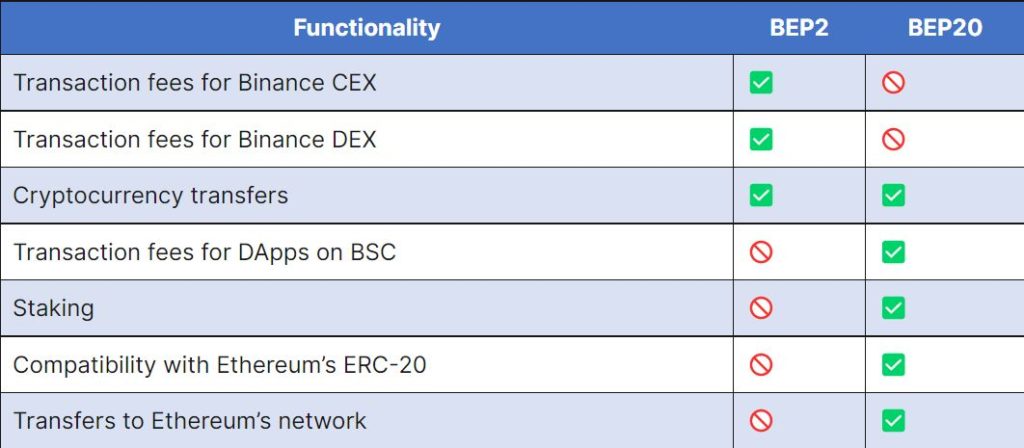
Source: pintu.co.id
Samples of the best BEP-2 tokens are the BUSD token. This is a regulated USD-backed stablecoin. The BTCB token is another sample. This is a coin that is 100% backed by BTC. Many other coins have also seen a BEP-2 release. For instance, Fantom (FTM), Polygon (MATIC), or Cardano (ADA). Also, Bitcoin can be a BEP-2 token. However, this is not the native token the way it appears on its native chain.
What Is the CW20 Token Standard?
The CW20 token is a standard based on CosmWasm. This is part of the Cosmos network. It is like a library that has all kind of different modules to build a smart contract.
It’s also a fungible token. Cosmos based its design around the ERC-20 token standard. However, it saw many changes as well. Among others, it handles balances and transfers.
The Terra blockchain is native to Cosmos. This makes Anchor (ANC), TerraLuna (LUNA), and TerraUSD (UST) native CW20 tokens.
What Is the Omni Token Standard?
You can find the Omni layer on top of the Bitcoin blockchain. It allows you to create a custom currency in their free web wallet. This is the Omni wallet. These assets can have smart contracts, in contrast to Bitcoin itself. The transactions take place on the Bitcoin chain. On the Omni layer, you can organize crowdfunding and trade P2P.
The OMNI token is the native token that has the Omni token standard. Furthermore, the MaidSafeCoin (MAID) has an Omni token standard. Although the Tether (USDT) native token is on ERC-20, it also has an Omni token version.
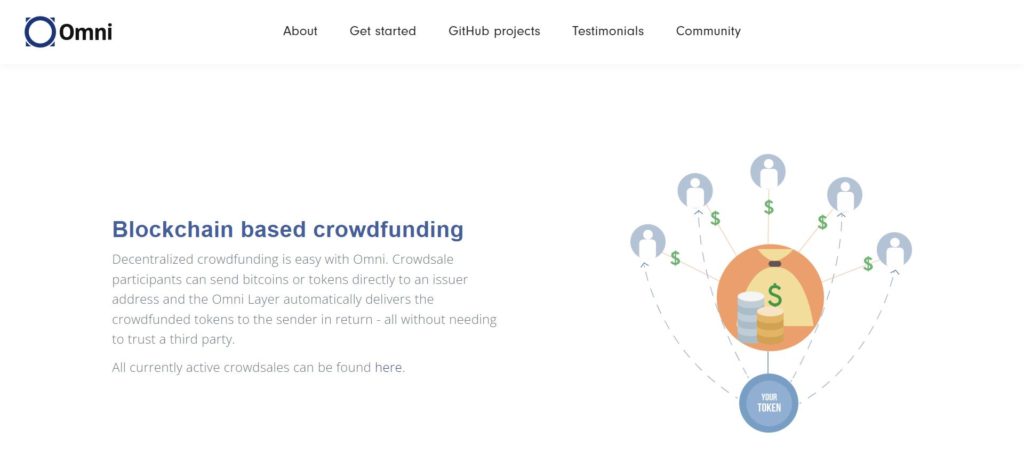
Source: Omni layer
Conclusion
So, here we are with lots of information about four different token standards. It shows that the standards vary from chain to chain. As a result, it is always better to have the original version of a token, or the native token. However, there are situations when it is helpful or useful to have a different token standard.
For example, if you want to send USDT, the costs vary depending on what standard you use. The native ERC-20 standard will have high gas fees. On the other hand, USDT sending via Tron or as a BEP-20 token on the BNB chain is a lot cheaper.
⬆️ Also, get $125 for SIGNING UP with MEXC Exchange (FREE $25 in your MEXC wallet + 1-month ALTCOIN BUZZ ACCESS PRO membership (worth $99). MEXC supports U.S. Traders in all trading pairs and services.
(To get your ALTCOIN BUZZ ACCESS PRO membership, DM us with your “newly signed up MEXC UID” and “Telegram ID” on our Twitter @altcoinbuzzio)
⬆️In addition, find the most undervalued gems, up-to-date research and NFT buys with Altcoin Buzz Access. Join us for $99 per month now.
⬆️Finally, for more cryptocurrency news, check out the Altcoin Buzz YouTube channel.
Next up
Sui Gains 4.5% as Samsung Wallet and AI Agent Infrastructure Drive Attention
Sui (SUI) gained around 4.5% over a 24-hour period as investors weighed its upcoming Samsung Wallet integration, new AI infrastructure developments, and rising
 SUI
SUI